Knowledge Series · Rare Earth Elements
Understanding the Rare Earth Supply Chain: From Mine to Magnet
Rare earth elements are essential for electric vehicles, wind turbines, robotics, defense systems and many other advanced technologies. But the real story is not only about mining. The key to understanding rare earths lies in the full supply chain — from ore extraction to high-performance magnets.
Why Rare Earth Elements Matter
Rare earth elements (REEs) have become one of the most strategically important resources of the 21st century. They are critical components in electric vehicles, wind turbines, robotics, defense systems, semiconductors and many other advanced technologies.
Despite their name, rare earth elements are not necessarily rare in the Earth's crust. The real challenge lies in extracting, separating, refining and transforming them into industrial materials that can be used in high-tech applications.
For investors, traders and policymakers, understanding the rare earth supply chain is essential. The industry is often discussed as a mining story, but in reality the greatest strategic value lies further downstream.
What Are Rare Earth Elements?
Rare earth elements are a group of 17 metallic elements that share similar chemical properties. They are typically divided into two categories:
Light Rare Earth Elements (LREEs)
- Lanthanum (La)
- Cerium (Ce)
- Praseodymium (Pr)
- Neodymium (Nd)
- Samarium (Sm)
- Europium (Eu)
Neodymium and praseodymium are particularly important because they are used in powerful permanent magnets.
Heavy Rare Earth Elements (HREEs)
- Gadolinium (Gd)
- Terbium (Tb)
- Dysprosium (Dy)
- Holmium (Ho)
- Erbium (Er)
- Thulium (Tm)
- Ytterbium (Yb)
- Lutetium (Lu)
Dysprosium and terbium are especially valuable because they improve the performance of high-temperature permanent magnets used in electric vehicles and wind turbines.
The Rare Earth Supply Chain
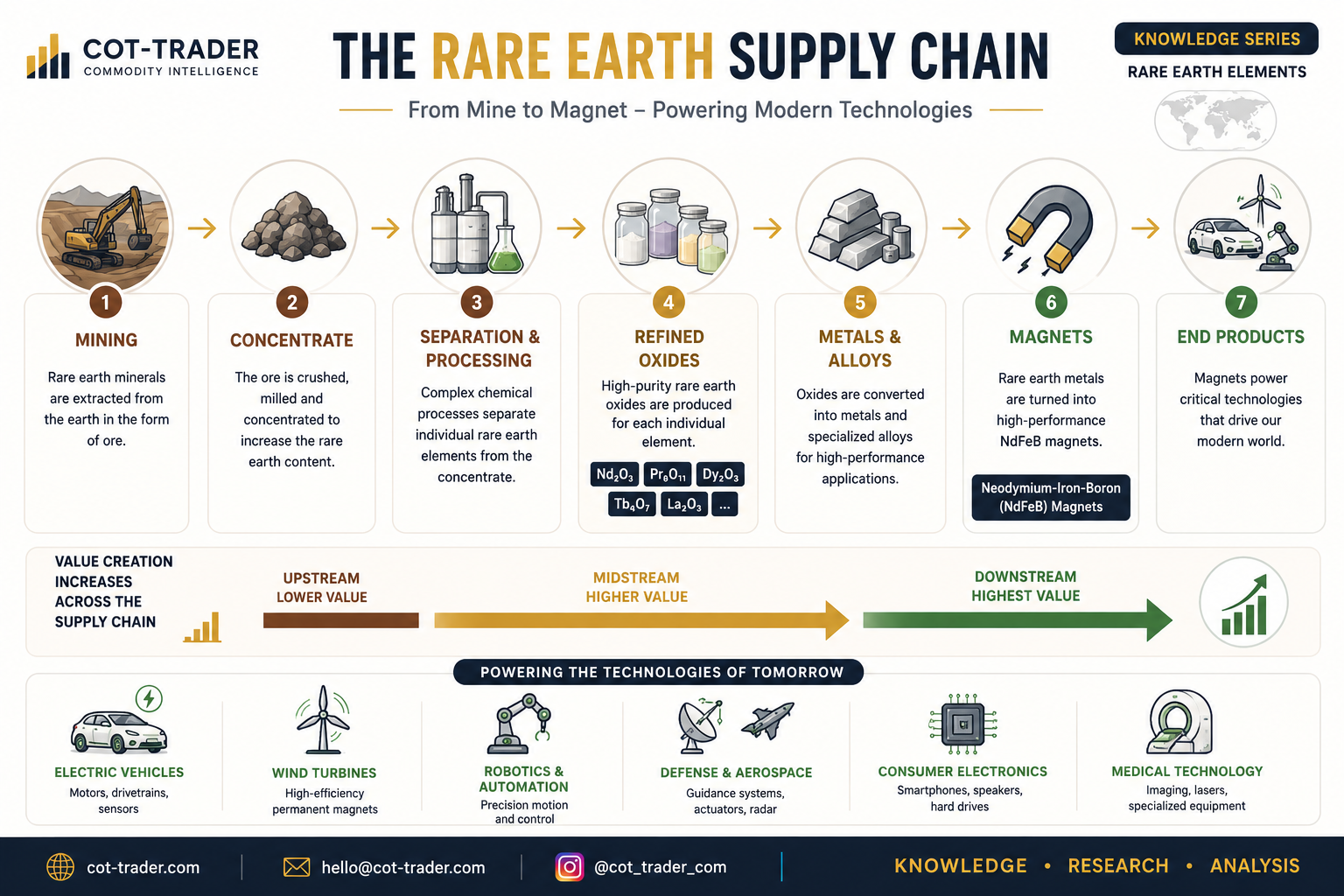
The rare earth value chain can be simplified into seven major stages:
- Mining – Rare earth-bearing ore is extracted from the ground.
- Concentration – Ore is crushed and concentrated to increase rare earth content.
- Separation & Processing – Individual rare earth elements are separated through complex chemical processes.
- Refined Oxides – High-purity rare earth oxides are produced.
- Metals & Alloys – Oxides are converted into metals and specialized alloys.
- Magnet Manufacturing – Rare earth metals are transformed into high-performance NdFeB magnets.
- End Products – Magnets power technologies such as EVs, wind turbines, robotics and defense systems.
While mining attracts most of the public attention, it is only the first step. Processing, refining and magnet manufacturing are often where the highest value is created.
The Processing Bottleneck
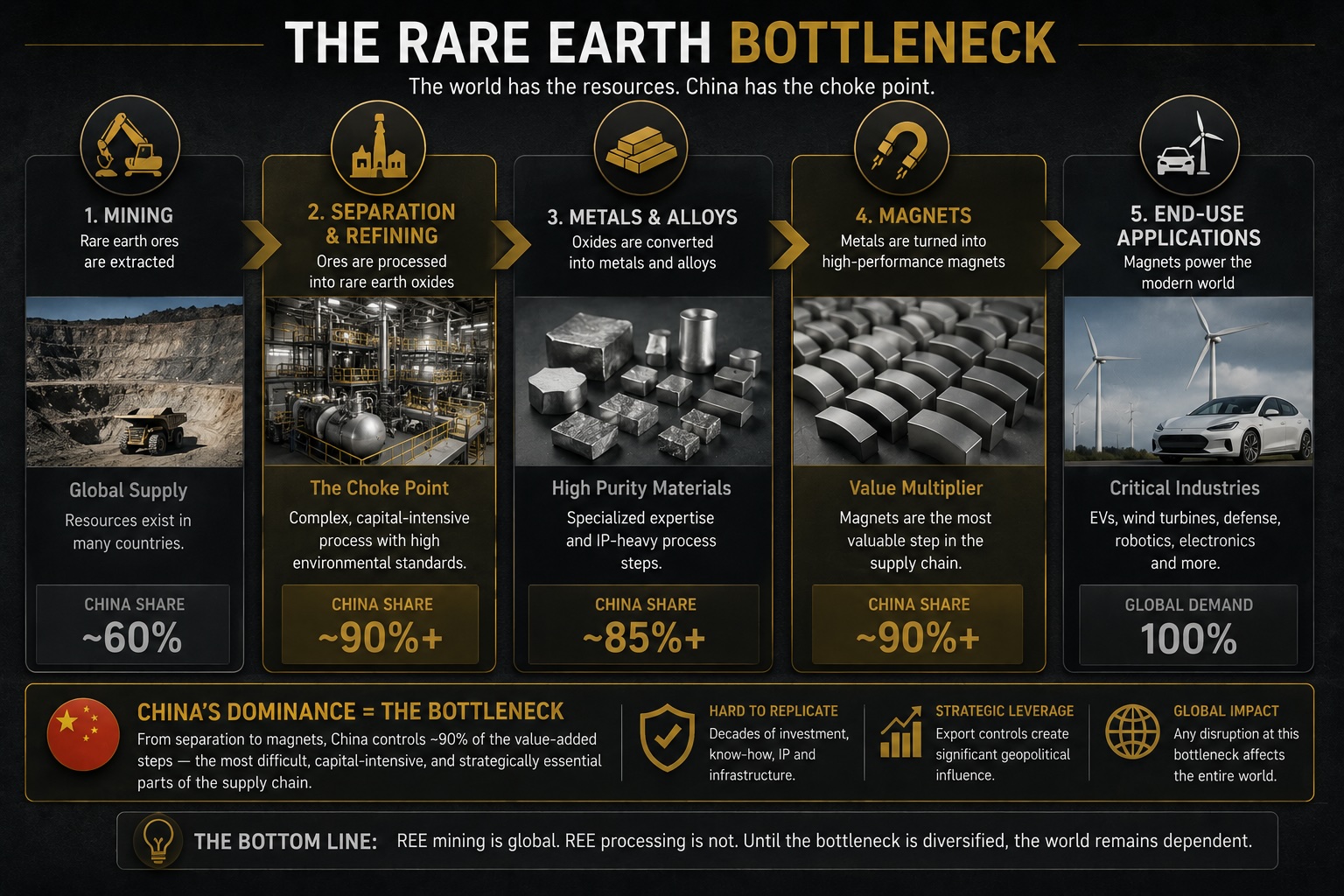
Processing is the most critical bottleneck in the entire rare earth industry. Rare earth elements have very similar chemical characteristics, making separation technically challenging and capital intensive.
A mining project may successfully produce concentrate, but without access to separation and refining facilities, that concentrate cannot be transformed into usable industrial materials.
This explains why governments around the world are investing heavily in processing infrastructure. Building a mine is difficult. Building a complete rare earth ecosystem is far more challenging.
Why Magnets Drive Demand
One of the most important end uses for rare earth elements is the production of permanent magnets.
Neodymium-Iron-Boron (NdFeB) magnets are widely used in:
- Electric vehicles
- Wind turbines
- Industrial automation
- Robotics
- Consumer electronics
- Medical technology
- Aerospace and defense systems
These magnets offer exceptional performance relative to their size and are difficult to replace in many critical applications.
China's Dominance in the Supply Chain
China occupies a dominant position across multiple stages of the rare earth value chain. While the country remains a major producer of rare earth ore, its leadership in separation, refining and magnet manufacturing is even more significant.
This concentration creates strategic dependencies for industries around the world. Electric vehicle manufacturers, renewable energy companies, aerospace suppliers and defense contractors all depend on a stable supply of rare earth materials.
As a result, governments in North America, Europe and Australia are actively investing in alternative supply chains to reduce dependence on a single region.
Why Investors Should Look Beyond Mining
Many investors focus solely on mining companies when evaluating rare earth opportunities. However, mining represents only one part of a much larger value chain.
Key competitive advantages often exist further downstream:
- Processing and separation facilities
- Refining expertise
- Metal and alloy production
- Magnet manufacturing capabilities
- Access to strategic end markets
Understanding where a company operates within the supply chain is often more important than simply knowing what it mines.
Key Risks Facing the Industry
Geopolitical Risk
Export controls, trade restrictions and geopolitical tensions can significantly impact global supply chains.
Environmental Challenges
Rare earth processing requires strict environmental controls and responsible waste management.
Project Development Risk
New mines and processing facilities often require substantial capital investment and many years of development.
Price Volatility
Rare earth markets are relatively small and can experience significant price fluctuations.
Conclusion
Rare earth elements are critical building blocks of modern technology, but the industry's complexity is often underestimated.
Mining is only the first step in a much longer journey that includes processing, refining, alloy production, magnet manufacturing and final applications.
Understanding this supply chain helps investors identify where value is created, where bottlenecks exist and why governments around the world are increasingly focused on securing access to these strategic materials.
In the next article of our Rare Earth Elements Knowledge Series, we will examine how China built its dominant position and why Western nations are now trying to establish alternative supply chains.
China's Dominance in Rare Earths: How One Country Built Control of the Industry